hmong-mina

Hmong History and Cultural Studies

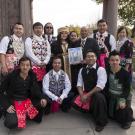
A few of the hundreds of participants at the 10th-annual Hmong New Year Celebration in downtown Chico, California, pose for their portrait taken by Carol M. Highsmith.

Hmong Communities in California

HSS 11.11, HSS 11.11.1, RI.11-12.7, W.11-12.6

Through learning about the early settlement of Hmong communities in California and Central Valley, students will gain an understanding of highly populated locations/demographics and examples of civic engagement, economies, and cultural festivities of the Hmong communities.
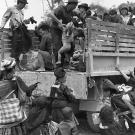
Hmong people climbing on to a truck in Ban Xon. Site: LS-272, Coordinates: TF 5994

War and Home - Part II

HSS 10.9.2, RI.9-10.7, W.9-10.4

This lesson is the continuation to Part I lesson that focuses on war and home. Part II focuses on how wars affect people’s relationships with homelands. Students will use the US’s Secret War in Laos as a case study to show how war disrupted Hmong people’s lives and homes and explore how displaced individuals and groups create home and belonging in the United States.

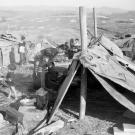
A displaced Hmong family in Luang Prabang. Site: L-54, Coordinates: TH 0302

War and Home - Part I

HSS 10.9.2, RI.9-10.2, W.9-10.4

War displaces people from their homes and transforms communities all over the world. This lesson is the introduction of two lessons that focus on war and home. Students will learn about the historical context of Hmong involvement and experience during the US’s Secret War in Laos to explore how war affects people’s concept of home.

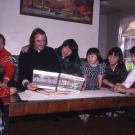
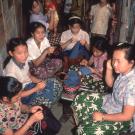
First generation Hmong children in the mid 1980s listening to a Catholic priest read “Where the Wild Things Are.”

Religious Sponsorship

HSS 11.9, HSS 11.11.1, RI.11-12.7, W.11-12.9

Students will learn about the different kinds of sponsorship and approaches to integrating Hmong refugees into various communities in the United States. Students will generate an inquiry to discuss the issues around religious sponsorships and its impact on Hmong religious beliefs.

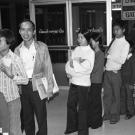
New Year Celebration in Santa Ana in 1984.

Grounding of Homeland and Statelessness

HSS 6.6, RI.6.2, RI.6.4

Students will learn the complex history of Hmong people as a ‘stateless’ people, having no geographical homeland to call their own. Students will explore how statelessness has affected Hmong people’s desire and search for sovereignty and homeland and dive into how being stateless has affected their conception of home-making, sense of belonging and community building.

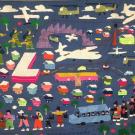
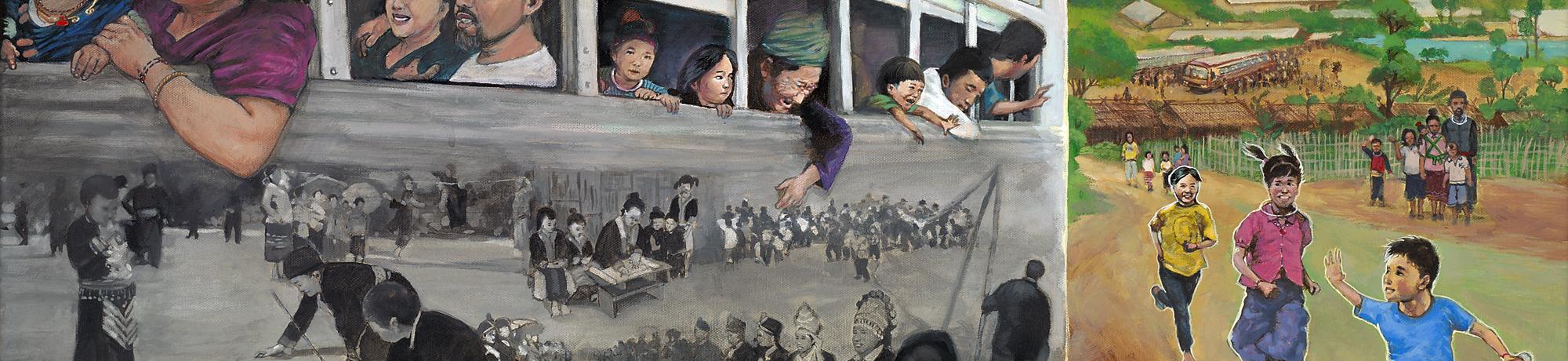
Top - refugees fleeing Laos & Bottom - line of people Hmong Story Cloth

From Laos to the United States

HSS 2.1.1, HSS 2.2.3, RL.2.7, W.2.3

After reading the story “Dia’s Story Cloth,” students will be able to describe how Dia’s life was affected or changed by the Secret War in Laos, locate Southeast Asia on a map, and explain why Hmong people moved to Southeast Asia and came to America.

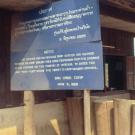
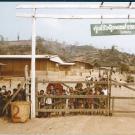
The gated entrance to Nam Yao Camp in Nan taken by Paul Paquette in 1980.

Critical Hope of Hmong People in Thailand Refugee Camps

HSS 11.9.3, RI.11-12.7, W.11-12.4, SL.11-12.1

Students will develop a deep understanding of life in the refugee camps by examining primary source documents, images, and interviews. Students will be able to identify how Hmong socially and economically created a camp culture of hope and resilience that allowed them to cope with the poor human conditions of the camp, the traumas of war, and separation through group discussions and share outs.