
hmong-mina

Hmong History and Cultural Studies

Bombshells left over from the US secret bombing during the Vietnam War, lined up in a village outside Phonsavan.

Secret War in Laos (Multiple Perspectives)

HSS 10.9, HSS 11.9.3, RI.11-12.7, W.11-12.1

Through analyzing primary sources and historical documents, students will learn about the ‘Secret War’ in Laos in which Laotian civilians and the Royal Lao Army special forces, known as the ‘Special Guerrilla Units,’ supported the American covert war efforts in Laos. Students will share their viewpoints about secret bombings and US’s involvement in collaborative activities and a Four Corner Discussion.

Mien refugees in northern Thailand refugee camps during 1980-1983 taken by Erica Hagen.

Ethnic Diversity of Laos

HSS 6.6, RI.7.1, W.8.6, WL.CL2.S: Cultural Products, Practices, and Perspectives

Students will be able to define the term "Laotian" and differentiate between the three groups (Lao Loum, Lao Theung, and Lao Sung) that make up the ethnic diversity of Laos through collaborative group research projects. By the end of the lesson, students will understand that ‘Laotian’ includes, but is not limited to, the Lao, Iu Mien, Khmu, Phutai, Tai Lue, Tai Dam, and Tai Deng ethnic groups.

Chinese watercolor paintings of Miao people (Hmong) circa 1736 from Chinese Rare Book Collection.

The Origin of the Hmong in China

HSS 10.4, W.9-10.7, SL.9-10.1, RL.9-10.2

Students will learn the roots of the Hmong people in China and how displacement through persecution and war has led to the Hmong migrating south to Laos, Thailand and Vietnam. Through a platform of their choice, students will summarize and express the origin and identity of Hmong people and how it has been impacted by a history of being colonized, persecuted, and stateless.

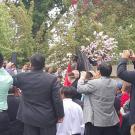
Hmong New Year Celebration in Merced, CA in 2008.

HMoob New Year Celebration

HSS 4.4, RI.5.7, W.4.6, WL.CN2.N: Diverse Perspectives and Distinctive Viewpoints

Students will gather that HMoob New Year is interconnected to spirituality and the significance of community and family and fosters an appreciation for the richness and uniqueness of culture and traditions sustained throughout the many displacements and oppressions HMoob people experienced. By learning about the purpose and aspects of the HMoob New Year Celebration (as a public event in the United States), students will compare and contrast their own new year celebrations.

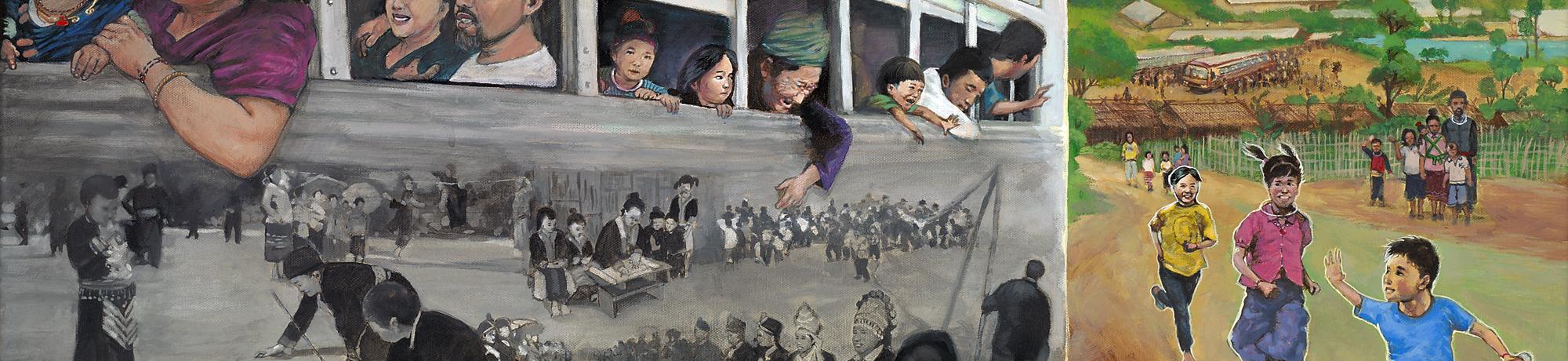
Story cloth narrating Hmong migration from Hmongstory Legacy Collection.

Narrating Hmong Migration

HSS 3.3.3, RI.3.7, SL.3.4

Students will be able to understand the importance of intergenerational storytelling by listening and discussing with an elder family or community member. Students will explain and describe their own migration and/or daily life story as a way to practice narrating their own stories.

This is early in the years before the story cloths became more streamlined and look alike. In the early years the story cloths reflected more first hand accounts and looked more custom and unique before they began to have the cookie cutter look.

The Story Behind Paj Ntaub (Story Cloth)

HSS 4.4, RI.5.7, W.4.2, SL.5.4

Students will learn about the history of the story cloth and its importance in communicating Hmong history, refugee and migration experience, and preservation of culture. Students will analyze a paj ntaub, and interpret the message, story or feeling that the artist is trying to convey.